

About Juniper Berry (Juniperus communis)
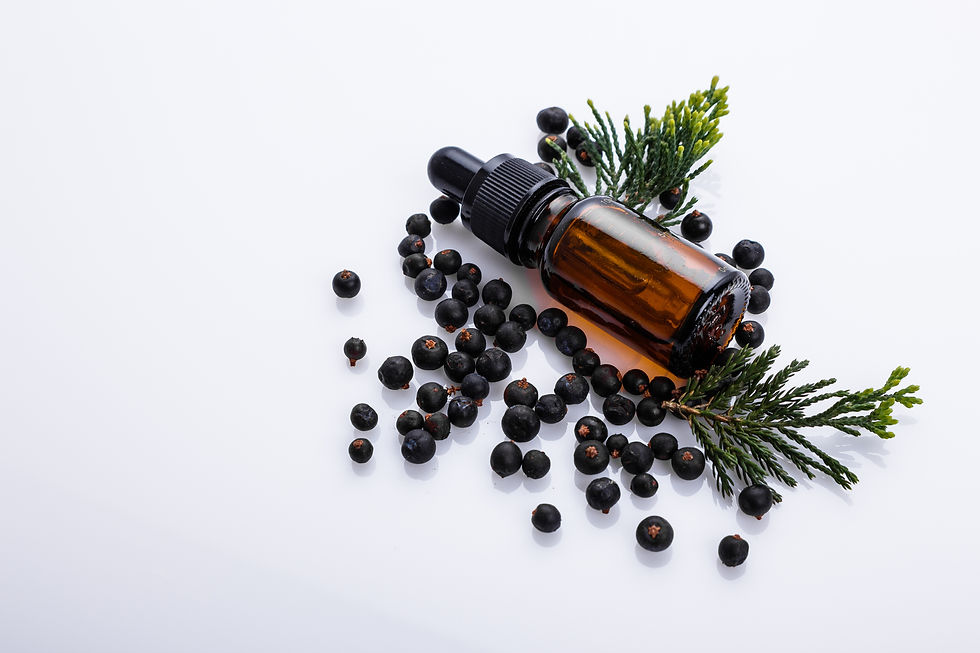
Juniperus communis is a tree reaching about 6.5 feet in height. Its leaves are needle-like; it has greenish-yellow flowers, and small berries.
According to Salvatore Battagglia’s book “The Complete Guide to Aromatherapy” the “best berries are collected in northern Italy, Austria, Czech Republic, Hungary, Croatia, Serbia, and France.” Other sources are Macedonia, Bulgaria, and India. The berries are steam distilled and have a top-middle note that has a fresh, woody, sweet, and pine needle type of aroma.
While many people associate juniper berries with gin it is used in a variety of ways. There are quite of few recipes online for deserts that contain this berry. It is also used when cooking game meat. Some even use it to make tea.
Juniper Berry is commonly used as a diuretic treatment as it considered a urinary antiseptic. It is also used for a variety of gastrointestinal problems.
Even though the berry is widely used for these purposes, it is important to note that when taken internally the essential oil should not be used. It is best to stick with recipes using the actual berry.
That being said, the essential oil can be a powerful ingredient in aromatherapy blends.
Therapeutic Properties and Clinical Application
Tissue Congestion and Fluid Retention
As stated above, one of the most common uses of Juniper Berry essential oil is the inclusion of blends that are used as a diuretic. The aromatherapist will add it to a cream, or other carriers that you message onto the kidney area.
Since it is used a diuretic, it can also be used in bends for edema, lymph congestion, bloating, and other types of fluid retention.
Musculoskeletal
This essential oil is Analgesic, Anti-inflammatory, Antirheumatic, Antispasmodic, and a Circulatory stimulant. As such it is a good addition in blends for musculoskeletal issues.
It is often used in massage blends for aches and pains. After physical activity it can be added to bath salt blends. Here the warm bath will work together with essential oils to help alleviate pain associated with aching muscles.
It’s anti-inflammatory, antirheumatic, and warming properties make it a good candidate for inclusion of rheumatic blends. As a circulatory stimulant it can promote vasodilation and help increase local blood circulation.
Skin Care
Juniper Berry essential oil is also considered to be antimicrobial, antioxidant, and astringent. These qualities make it an excellent addition to various skin care blends where it can help cleanse and heal infected skin areas. One such application is acne. I use it in a blend for my daughter who occasionally has an acne outbreak. She has noticed that my blend seems to work much better than over the counter acne medications.
Safety
Though considered non-toxic it may cause skin irritation or sensitization. For this reason, it is best to use a low dilution when applied topically. The shelf life of Juniper Berry is about 3 years from distillation.
Tisserand & Young “Essential Oil Safety”
According to Tisserand & Young state this oil should be kept in a dark, airtight container and stored in the refrigerator to help avoid oxidization. In the early to mid 1900’s Juniper Berry oil acquired a bad reputation in various texts where it was considered to be an emmenagogue oil that produces an abortion. However, this had been a confusion between two different types of oils. The early studies refer to Juniperus sabina, whose common name is Savin, which is distilled from the leaves and terminal branches. This oil is in fact known to be Hazardous: Embryo-fetotoxicity; abortifacient (causing abortion); hepatotoxic (toxic to the liver). In fact, Savin oil is prohibited to use in cosmetics in both the EU and Canada. In the UK it can be used in blends sold in a pharmacy under the direct supervision of a pharmacist.
The oil we commonly call Juniper Berry Juniperus communis has been studied and is considered safe. However, as will with all essential oil use, consult with an aromatherapist before using it during pregnancy. Just because it is natural does not mean it is safe in all applications.
Side Note on Safety
One reason why some oils cause skin irritation and even lead to sensitization (where you can no longer use a particular oil) is that they oxidize. All essential oils will eventually oxidize, but at different rates. For this reason, I keep all of my essential oils and carriers in the refrigerator. They should not be kept/stored in direct sunlight or in a warm place. This will speed up the expiration date. If you feel the need to keep the oil by you then the best is to transfer a small amount into an 8 dram amber bottle and keep the rest refrigerated.
Have a Great Week!!!
ELizabete Desire’ Freijs, NAHA Certified Professional Aromatherapist


Comments